01 / Visible problem
What was happening
Complex tickets could take around one to two hours to write manually. Leadership decisions needed more than frustration or isolated incidents. Customer onboarding, email and payment also depended on manual handoffs.
02 / Investigation
What I looked at
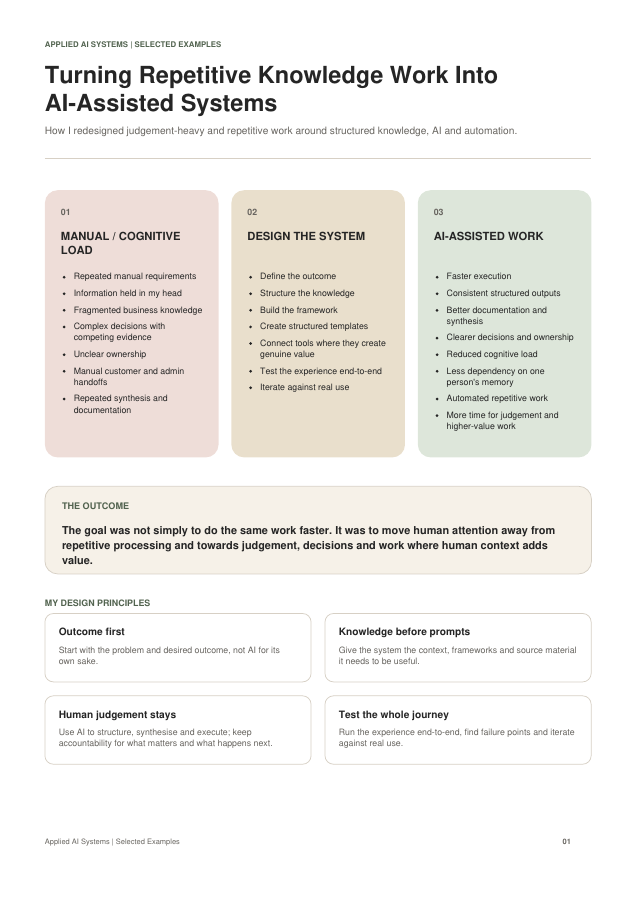
For each use, I started with the desired outcome, then structured the knowledge, context, frameworks, instructions and templates the system needed. I tested the whole experience and kept human judgement in the decisions that mattered.
03 / What changed
The shift
A custom GPT turned spoken context, screenshots and failure points into a structured requirements draft for review. An evidence-support GPT organized expectations, incidents and recurring patterns to challenge my interpretation. Forms, Make, MailerLite and Stripe connected customer actions to routine communications and payment steps. I also built systems for process improvement, product and proposition support, Compass, and repeatable client delivery.
04 / Result or decision
What the evidence made possible
Complex requirements work typically fell from around one to two hours to roughly 20–30 minutes, with more consistent structure and documentation. Routine customer handoffs happen automatically. In decision support, I defined the criteria and made the final decision; the accumulated evidence supported ending the CTO relationship. AI accelerated synthesis, documentation and execution; it did not replace my judgement.
Design around the outcome, give the system the knowledge it needs, test it in real use, and keep accountability for judgement and the final decision.